Here is a link where you can see the newest “lively quotation” video from Jean Vanier, produced by the Jean Vanier Associatrion with images by Voices and Colors (manu, Marie-Laure Turmel). The music is my 1978 composition “Du monde en ville”, the percussion played by Roch Tassé.
Archive for the 'Non classé' Category
07
Jan
Newest “lively quotation” from Jean Vanier
posted by R.A.Seguin in Non classé and have No Comments
19
Dec
The Séguin brothers – Le conseil de guerre
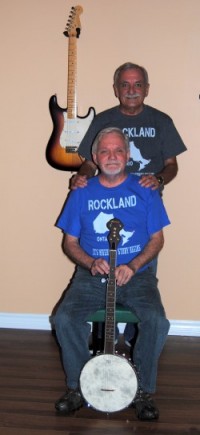
Bob and Richard
“Le conseil de guerre” (The War Council) is a traditional piece dating back to the Napoleonic Wars. It was discovered by Pierre Bensusan, the brilliant French-Algerian singer-guitarist. In our arrangement, the second part of the instrumental sequence in the middle of the song is another traditional piece called “Douce dame jolie”, which dates back the Middle Ages.
Our version of this piece lasts almost eight minutes. I remember when all pop songs were radio-friendly with a maximum length of three minutes. Bob Dylan was the first to break this barrier with the publication of “Like A Rolling Stone” in 1965, although his own record label (Columbia Records) and several DJs tried to hinder him. But even at six and a half minutes, “Like A Rolling Stone” was too popular to be obstructed and paved the way for artists who wanted to take the required time to express themselves, without the restrictions of the music industry. Soon, we had “In-A-Gadda-Da-Vida” by Iron Butterfly, which, at seventeen minutes, took up a whole side of a vinyl record.
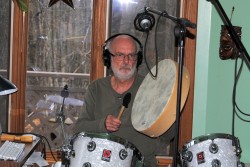
Roch and his buffalo drum
On the long list of human stupidity, war is certainly at the top of page one. We’re not the first ones to choose this time of peace to sensitize people to the folly of war – in December 1971, John Lennon released “Happy Xmas (War Is Over)” in protest to the Vietnam war. So we wish you, Bob, Roch and myself, a merry Christmas and happiness in the coming year.
Peace on earth. War is over.
Bob Séguin: voice
Richard Séguin: guitars (acoustic, electric, 12-string), banjo, merlin, MIDI guitar (viola, fiddle)
Roch Tassé: drums and percussion
posted by R.A.Seguin in Non classé and have No Comments
16
Nov
The Séguin brothers – Girl from the North Country
Mon pays ce n’est pas un pays, c’est l’hiver.
Gilles Vigneault

Bob and Richard Séguin
“Girl from the North Country”, perhaps Dylan’s most romantic composition, was published in 1962 and it spoke to me the first time I heard it. The north has always been special to me – I was born in the middle of a Canadian winter, my brother Bob towards the end of one. I’ve always equated the north with austerity and isolation, it’s people somehow worthier or more principaled. I loved the song so much that I named one of my first compositions “Fille du nord”, the musical representation of an ideal.
Dylan’s composition is fast paced, definitely folk music, and features some of his best finger-picking guitar playing. My arrangement is very different, much slower and definitely R&B, a style I’ve always loved.
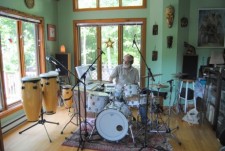
Roch Tassé
Bob Séguin – voice
Richard Séguin – acoustic guitar, electric guitar, electric bass, MIDI guitar (B3 organ)
Roch Tassé – drums
posted by R.A.Seguin in Non classé and have No Comments
23
Oct
The Séguin brothers – My Back Pages

The Séguin brothers
My brother and I are very lucky – we grew up in a small country town, sons of parents who believed in the great outdoors, where we played and spent most of our youth. We were also very lucky to come of age in the 60s, both of us captivated by the popular music of that time, a completely different experience from today’s popular music. Where music is now completely controlled by the industry, a money-making cash cow that spits out innocuous dance music sung by innocuous “artists”, we grew up with Bob Dylan, The Beatles and The Rolling Stones. In the 60s the artists themselves controlled the music business, which is obvious when you hear the popular songs everyone listened to back then. The music industry would not allow this today. Do you think songs like “For What It’s Worth” would be promoted today? “Universal Soldier”? “Turn, Turn, Turn”?
It is easy to forget what a huge force Bob Dylan was in the early 60s. Starting with “Blowing in the Wind” and “The Times They Are A-Changin'”, anthems for our generation, Dylan composed songs of political and social import that propelled widespread protest against the inequities of the times. “My Back Pages”, composed in 1964, looks back at the strife of young manhood and moves away from it, as Dylan soon did. The definitive version of this song came in 1967 from The Byrds and, thanks to Roger McGuinn’s voice and electric 12-string guitar, it’s an arrangement that simply can’t be improved upon. I wanted to emphasize the song’s lofty qualities and chose a cathedral setting for my arrangement.
After spending a day outside in the sun last summer, Bob dreamed that night of our youth, the blue skies, the forest trails, the open fields, the freedom we embraced. When he awoke, he immediately wrote down his dream and we included it as the lyrics to the last verse of the song, what we refer to as the dream sequence.
Here’s our version of “My Back Pages.”
Bob Séguin: voice and additional lyrics
Richard Séguin: MIDI guitar (B3 organ)
posted by R.A.Seguin in Non classé and have No Comments
18
Oct
The Séguin brothers – Friend of the Devil

The Séguin brothers
The rock band The Grateful Dead came out of the whole California, Summer of Love, hippie culture that changed public awareness about most social standards in the late 1960s. “Friend of the Devil” was part of The Dead’s 1970 album, “American Beauty”, which expanded on the band’s folk and country roots first explored on the album “Workingman’s Dead”, also released in 1970. Jerry Garcia (1942-1995), the perceived leader of The Grateful Dead, wrote the song with John Dawson of the New Riders of the Purle Sage, a popular country-rock band.
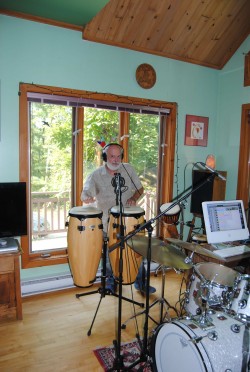
Roch Tassé
The song has been covered by dozens of artists and has become a folk/bluegrass staple over the years. People who have followed my early recordings know that acoustic music is very near to my heart and I’ve always wanted to form an acoustic band with other musicians. Our collaboration with Roch Tassé, who played percussion with me in the 1970s, allows us to do just that. We plan to record a number of acoustic numbers in the future.
Bob Séguin – voice
Richard Séguin – acoustic guitar, mandolin, MIDI guitar (upright bass)
Roch Tassé – congas, egg shaker, buffalo drum
Richard Séguin – acoustic guitar, mandolin, MIDI guitar (upright bass)
Roch Tassé – congas, egg shaker, buffalo drum
posted by R.A.Seguin in Non classé and have No Comments
02
Oct
The Séguin brothers – Something Fine

Bob and Richard
“Something Fine” is taken from Jackson Browne’s first album, which came out in 1972. By this time, Browne had already established himself throughout the industry as a gifted songwriter and he was able to collaborate with some of the very best singers and musicians on the planet for his own recordings: singers like David Crosby, Graham Nash, Glen Frey, Don Henley, Joni Mitchell and Bonnie Raitt; musicians like Jesse “Indian Ed” Davis, Albert Lee, Leland Sklar, Jim Keltner and especially David Lindley, whose inspired playing really defined Jackson Browne’s sound during his most successful years. Jackson Browne is now a member of the Rock and Roll Hall of Fame.
Jackson Browne is a fine singer but the best singers I everheard are Ray Charles and Aretha Franklin, without a doubt. Still, they weren’t even close to being my favourite singers. The singers I was drawn to the most were all different – powerful singers like Muddy Waters and Big Maybelle, expressive singers like Graham Parker and LaVern Baker, soulful singers like Wilson Pickett and Etta James. One of my favourite vocals is Blind Willie Johnson’s “Black Was The Night, Cold Was The Ground” and he doesn’t even sing a word; he just moans and plays his slide guitar. A little anecdote about Blind Willie, when the two Voyager space probes were launched in 1977 they contained an audio-visual record of the human race and its cultures for the benefit of any extra-terrestrials that might intercept it. Included on the record was the music of Mozart, Beethoven and Bach, alongside Chuck Berry and Blind Willie Johnson. That’s saying something.
I got the notion to record my brother’s voice by listening to “American Recordings” (1994), by Johnny Cash (1932-2003). Producer Rick Rubin brilliantly decided to record Cash alone in his living room, singing and playing his guitar. By this time, Cash was past his prime – his voice was weak and he was never much of a guitar player and yet these recordings are so phenomenal they won Cash a Grammy award. Listening to Cash, I finally understood what it was that all my favourite singers had in common, that thing that I had never been able to put my finger on. Like Cash, all my favourite singers had real voices, human voices, with all the precious imperfections kept in. It was the sound of humanity.
Blind Willie Johnson and the sound of humanity:
https://www.youtube.com/watch?v=EWw2X_yVcf8
My brother has always had a human voice. To me, you can’t improve upon that and you’d be a fool to try – which is the basis of my belief that the music industry is now run by fools. For our recordings, I wanted plain, even minimalistic arrangements of songs that would showcase Bob’s voice. “Something Fine” does that and also allows the two of us to just sing and play, plain and simple.
Bob Séguin: voice and harmonies
Richard Séguin: acoustic guitar, mandolin
posted by R.A.Seguin in Non classé and have No Comments
18
Sep
The Séguin brothers – Oxford Town
Bob and Richard Séguin
P.E. Trudeau once said that living next to the U.S.A. was like sleeping next to an elephant – you can’t help but be affected by what it does. In the 60s, we had mixed feelings about our southern neighbours: we loved the music, we hated the politics. It was a time of bigotry, racial riots, lynchings and murder. Such was the state of civil rights in the U.S.
I’ve heard it said that the purpose of art is to hold a mirror up to the face of the world. If so, the greatest artist of the 60s was Bob Dylan. Dylan took the folk music scene by storm at the start of the decade with his “protest songs”, of which “Oxford Town” was a prominent one.
“Oxford Town” was written for the James Meredith incident. On October 1, 1962, James Meredith, a black man, entered the campus of the University of Mississippi in Oxford as a student, the first African-American to do so. Meredith’s enrollment to the university sparked controversy and riots throughout Oxford. President John F. Kennedy sent U.S. Marshals to the campus and later, as the riots turned violent, the U.S. Border Patrol, the U.S. Army military police, and the Mississippi National Guard. It was a battle siege. When the tumult finally settled, hundreds were injured and two men were dead. James Meredith graduated from the University of Mississippi in 1963 with a degree in political science.
Dylan wrote “Oxford Town” in 1962, a deliciously subversive song played in a major key, with a happy melody contrasting the dark lyrics. In 1966, Richie Havens, one of Woodstock’s favourite sons, completely transformed the song into a brooding black civil rights anthem, sung in a minor key. Our version of “Oxford Town” is inspired by the late and great Richie Havens’ brilliant rendition of the song.
Roch Tassé
With this piece we can also introduce our collaborating musicians. Some of you may remember Roch Tassé, who played percussion on my first recordings. A long-time friend, Roch will add drums, congas and other percussion instruments to a number of our future recordings. I’ve known Paul Sorensen for almost 20 years and even as a 14-year-old, it was easy to see that he was a born musician.
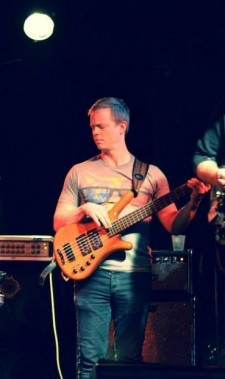
Paul Sorensen
Paul, a member of the Toronto Reggae/Afrobeat band The Fugitive Minds, will enhance some of our recordings with his excellent bass playing. Check out The Fugitive Minds website at://thefugitiveminds.com/
These musicians will form an acoustic band for some of our upcoming recordings, but this is our electric band. So turn up your speakers and listen to our version of “Oxford Town.”
Bob Séguin – voice
Richard Séguin – electric and acoustic guitars
Paul Sorensen – electric bass guitar
Roch Tassé – drums, congas, shaker
posted by R.A.Seguin in Non classé and have No Comments
07
Sep
The Séguin brothers – Across the Universe

In the 60s, my brother Bob was the leader, guitarist and singer in a rock group with which I took my first steps as a musician at the age of 15. My brother liked Gerry and the Pacemakers so we were called Robbie and the Trendsetters, later on simply The
Trend. Even though my life went in different directions than that of my brother’s, we were always very close. Now, after all these years, we want to reconnect with the music of our youth and present you with some new recordings. Also in The Trend was guitarist Tom Butterworth, who lent us his Wendover studio to record my brother’s voice.
The 60s decade was a period of great and tumultuous socio-cultural changes and the new popular music was at the forefront of those changes. It is difficult to exaggerate the importance and breadth The Beatles had in the everyday lives of us all at that time. As the music of the Beatles matured from the innocence of their early years to the sophistication of their masterpieces, young people followed in their tracks and emerged as adults. Beatles music was part of the repertoire of many amateur groups like ours and we marvelled at their exotic chords and their inspired melodies.
I remember the morning of the 9th of December, 1980. I was driving to work when I heard on the radio that John Lennon had been assassinated in New York the previous evening. There is little to say about this senseless tragedy, just another chapter in the endless book of human folly.
In the following weeks, we will present you with a series of recordings of songs we like, some accompanied by guest musicians. Looking back, my brother and I both feel that the only place to start is with The Beatles and we’ve chosen “Across the Universe” from the eventful year of 1969 – it was the best of times (Woodstock), it was the worst of times (Charlie Manson). Firmly in the Beatles’ repertoire, the song will nevertheless always be associated with its author, John Lennon, the man who sings that nothing’s going to change his world, the man who really did change the world.
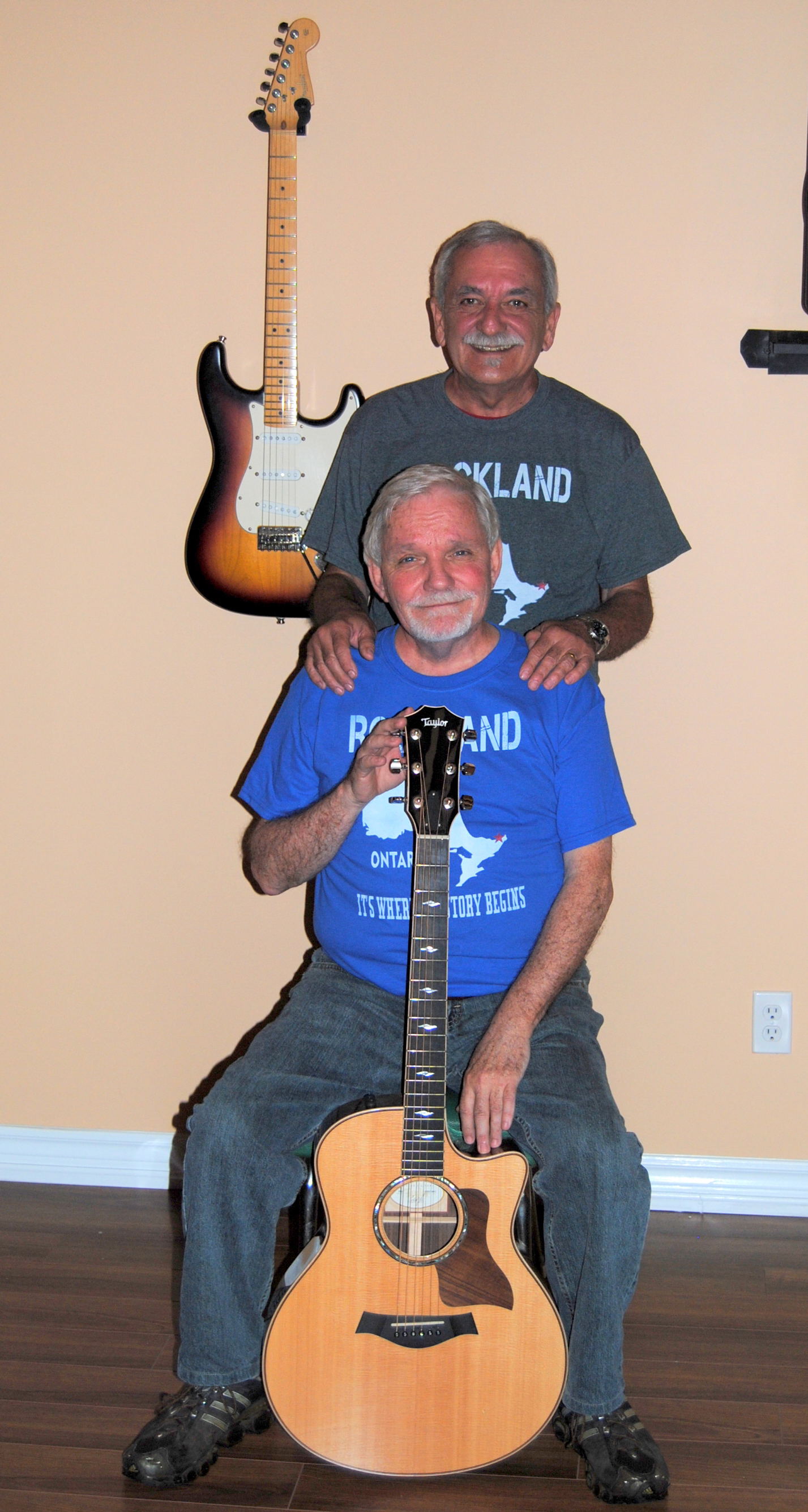
Bob & Richard
Here is our version of John Lennon’s classic “Across the Universe.”
Bob Séguin: voice
Richard Séguin: acoustic guitars, MIDI guitar (cellos, synthesizer), mandolin.
posted by R.A.Seguin in Non classé and have No Comments
04
Jun
A new instrument

Godin A8
Went to Metro Music to pick up my latest instrument, a Godin A8 mandolin. It sounds great amplified or acoustic. I’ve never played a mandolin before and, aside from the tiny neck, the challenge is the tuning – mandolins are tuned in fifths like fiddles, E-A-D-G from bottom to top, while guitars are tuned E-A-D-G from top to bottom! So playing a mandolin for me is like playing left-handed while looking in a mirror! There are also alternate ways of tuning the instrument which I’ll get into eventually.
Here’s an example of the A8’s sound, a small sample of Ry Cooder’s masterful “Billy the Kid.”
posted by R.A.Seguin in Non classé and have No Comments
21
Mar
Blues from the Mississippi Delta
In the 60s, when I was learning to play the guitar, all the hype was about three British guitarists: Eric Clapton, Jeff Beck and Jimmy Page. All three went on to have spectacular careers and they all came up playing the blues, all three of them at various times with the rock group The Yardbirds. Listening to them, I was introduced to the electric “Chicago” blues music of Muddy Waters, Howlin’ Wolf and Sonny Boy Williamson but Clapton’s great love of Robert Johnson’s music lead me south to the Mississippi delta, where a different brand of blues was being played by very different musicians.
I wasn’t ready for what I discovered – a world of obscure men (and a few women) who had picked up a guitar, bashed it mercilessly and shouted out their discontent for all the world to hear. It was “adult” music – none of that “She loves you, yeah, yeah, yeah.” It was “Goin’ down to Eli’s / Get my pistol out of pawn / When I got home / My woman was gone”; it was “Early this morning / When you knocked upon my door / I said “Hello Satan / I believe it’s time to go.” I immersed myself in their dark music, repetitive and hypnotic. What it was that captivated me so is difficult to express – if I had to choose a word, I would say “soul”, a simple and raw expression of the human condition.
These men were by no means “professional” musicians – they played every which way you could imagine, with glass bottlenecks (slides), on metal or cigar box guitars, using outlandish tunings. They were solo acoustic musicians, which was very appealing to me. I wanted to play like them – I loved the minimalism, I loved the abandon with which they played and sang, I loved the names: Sleepy John Estes, Pinetop Perkins, Peetie Wheatstraw (The Devil’s Son-in-Law).
One of the delta bluesmen who impressed me the most was Bukka White. Booker T. Washington “Bukka” White (1909-1977) had a wonderful plaintive voice and played a National steel guitar with a slide, the guitar tuned to an odd open E minor tuning. He is famous for many songs, including “Shake ‘Em On Down”, “Fixin’ To Die” and “Parchman Farm Blues” (White was convicted of a shooting incident and was sentenced in 1937 to the notoriously harsh Parchman Farm prison in rural Mississippi). The first piece I play here is my version of White’s “Fixin’ To Die.”
Again through Eric Clapton, who recorded “I’m So Glad” with his rock group Cream, I started listening to Skip James’ music. Nehemiah Curtis “Skip” James (1902-1969), like Bukka White, played in an open E minor tuning, which both men probably picked up from Henry Stuckey (1897-1966). Stuckey is said to have learned the tuning from Bahamian soldiers while serving in France during World War I.
James is also credited with “Cypress Grove Blues” which I play here, although my version is closer to Doc Watson’s definitive recording of the song. In the picture to the right, Mississippi John Hurt looks on as Skip James plays. My style of finger picking which is featured here owes a lot to Mississippi John’s playing.
The blues is not all gloom and doom and an important part is spiritual in nature. The third piece I play is the Reverend Robert Wilkins’ “Prodigal Son”, an exquisite retelling of the biblical parable. Reverend Robert Wilkins (1896-1987) is of Cherokee descent and was very popular during the 60s folk revival.
All these great bluesmen died in my lifetime, many when I was just a young man. Most people were as untroubled by their loss as they had been unaware of their presence. Their style of playing is now relegated to the past but I urge everyone to go to YouTube and listen to these greats of the 20th century.
posted by R.A.Seguin in Non classé and have No Comments
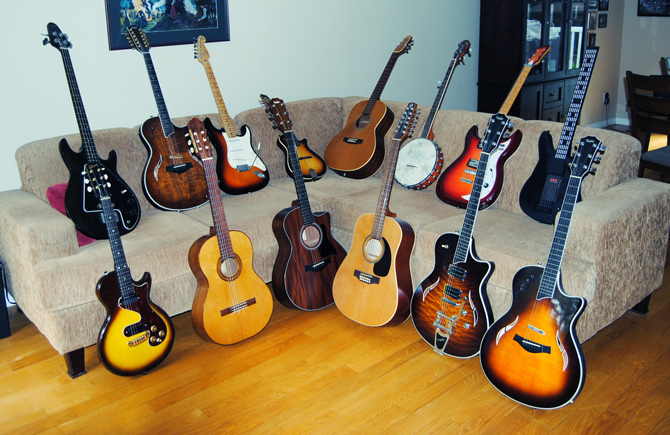
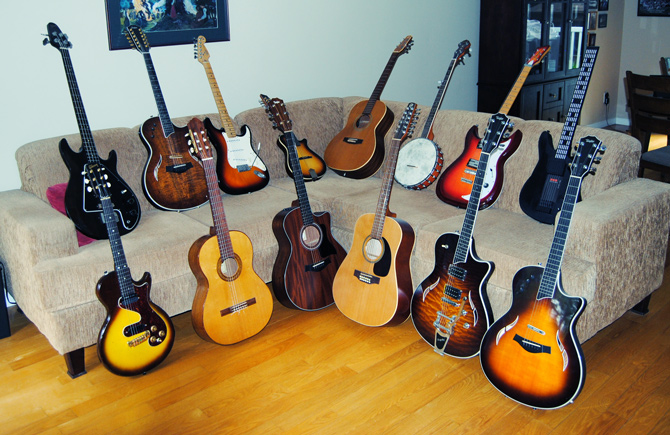
Some of my intruments